Drop off your CV
We'd love to hear from you. Send us your CV and one of our specialist consultants will be in touch.


The pharmaceutical manufacturing landscape is experiencing its most significant transformation in decades. For years, innovation and intellectual property remained internal, while Contract Development and Manufacturing Organizations (CDMOs) delivered the capacity, flexibility, and expertise required to scale.
However, that model is changing, as pharma tariffs, fragile supply chains, and complex next-generation therapies shift manufacturing from a support function to a core strategic priority. This is driving the sector into a new era shaped by hybrid manufacturing models and increased integration between pharma companies and CDMOs.
In this article, we explore how pharma’s manufacturing shift is reshaping CDMO partnerships, outsourcing strategy, quality expectations, and commercial leadership.
Contact CSG Talent to secure leaders who can support growth and innovation in the CDMO space.
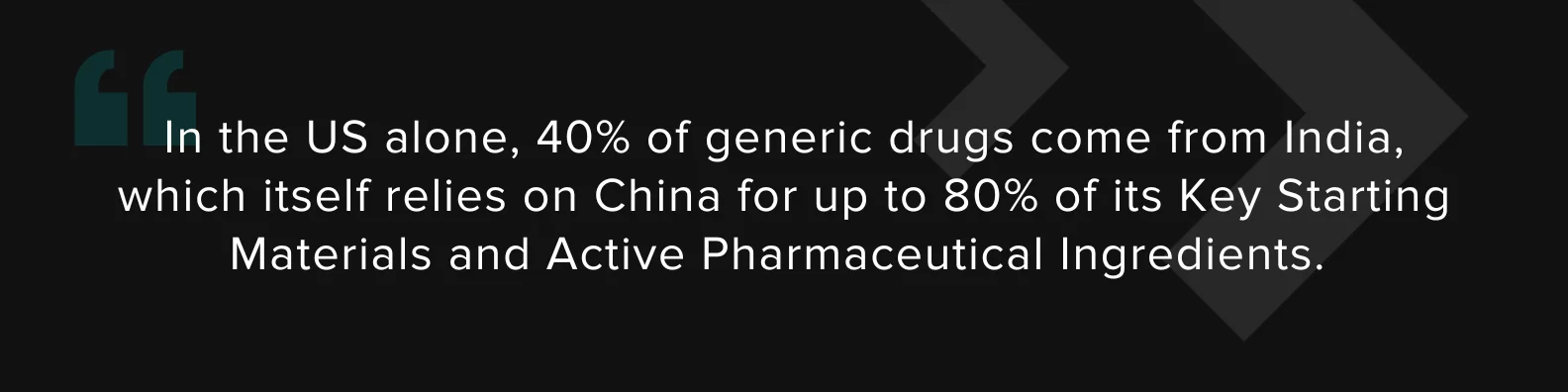
Pharmaceutical supply chains have been under immense pressure, exposing how dependent the global system has become on certain regions. In the US alone, 40% of generic drugs come from India, which itself relies on China for up to 80% of its Key Starting Materials (KSMs) and Active Pharmaceutical Ingredients (APIs). This creates a vulnerability that became especially clear during COVID-19 and through ongoing geopolitical tension.
Drug development has also become much more demanding. The average time from clinical trial launch to the completion of patient enrolment has increased by 26% in recent years. This extended timeline slows every part of the supply chain, adding pressure to both internal manufacturing teams and CDMO partners.
As a result, pharma companies now view manufacturing as a core strategic asset that protects supply chains and supports commercial performance in an increasingly competitive and unpredictable global market.
The acquisition of Catalent by Novo Holdings was a key turning point for the sector. Although framed as a long-term investment, the core driver was an accelerating demand for GLP-1 therapies, which had created a capacity challenge that could not be solved through the traditional CDMO model.
Novo Nordisk recognized that unless it secured guaranteed access to high-quality fill-finish operations, it risked facing product shortages and falling behind in one of the most competitive therapy areas globally. Therefore, bringing manufacturing in-house was a strategic move to protect supply, revenue, and market leadership.
The implications were felt across the industry. Competitors suddenly found themselves relying on a service provider owned by a direct rival, raising difficult questions around impartiality and future strategic focus. This transaction blurred the lines between clients and contractors, showing that a firm's operational capacity is now a key source of competitive advantage.
For the wider industry, the Catalent acquisition highlighted that even the strongest and most commercially promising molecule cannot succeed without the ability to manufacture reliably and at scale. It demonstrated why both pharma companies and CDMOs are reassessing how and where they build manufacturing capability.
In response to supply challenges, major pharma companies have launched some of the largest manufacturing investment programs the industry has ever seen. For example, Eli Lilly has committed more than $50 billion to expand its US footprint, including new mega-sites designed to support its growing portfolio. AstraZeneca has also invested $50 billion to strengthen its US manufacturing and R&D hubs.
Novartis has taken an even more ambitious approach by investing $23 billion into ten sites aimed at ensuring all US medicines can be manufactured domestically. Much of this investment focuses on radioligand therapy, an area where timing, quality, and precision manufacturing are critical.
Other organizations have opted for slightly different strategies. Both Johnson & Johnson and Amgen are investing heavily in biologics and next-gen modalities, while Roche has transferred its large Vacaville site to Lonza, showing how some companies are rebalancing existing assets rather than expanding them internally.
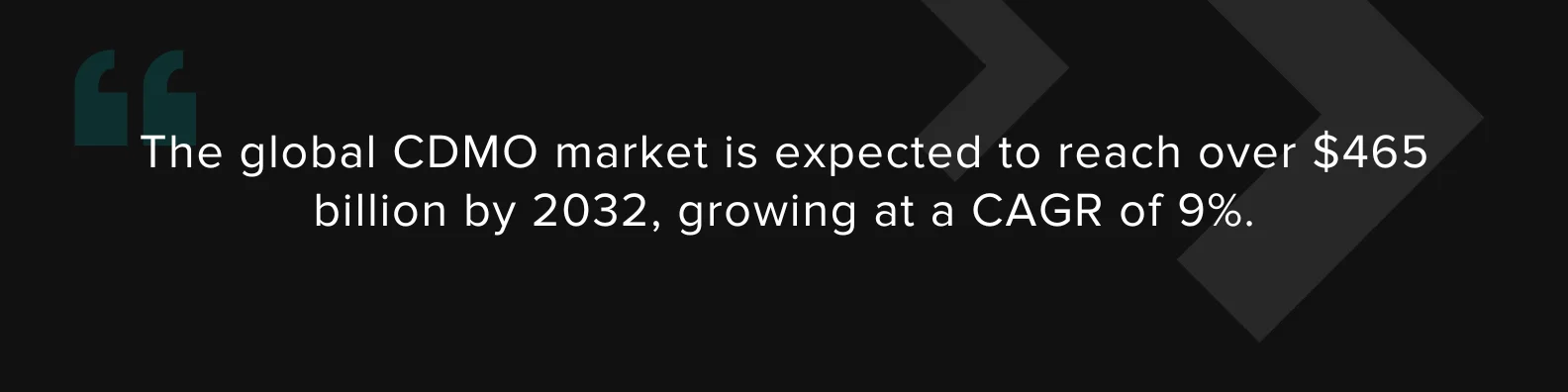
Despite this significant surge in internal investment, CDMO demand continues to rise at record pace. The global CDMO market is expected to reach over $465 billion by 2032, growing at a CAGR of 9%. North America leads the market with a 39% share, supported by strong clinical activity and close collaboration between pharma and biotech companies.
The biotechnology CDMO segment alone is expected to reach $200 billion by 2034, with oncology APIs accounting for approximately 36% of CDMO activity in 2024. Cell and gene therapies remain the fastest-growing category, driving demand for specialist skills and dedicated facilities.
Most promising therapies still rely on expertise that is difficult or inefficient for most pharma companies to develop internally. Many advanced modalities require specialized infrastructure that operates at a different scale and level of risk than traditional biologics, including:
At the same time, emerging biotech companies, which represent around 67% of the global pipeline, continue to depend on CDMOs to move from proof of concept to commercial delivery. Long-term, integrated collaborations are increasingly common, with arrangements like take-or-pay and capacity-reservation agreements influencing how both parties plan for future demand.
Higher levels of complexity lead to increased regulatory scrutiny, and failing to comply carries significant financial and reputational risks for organizations. Because of this, sponsors are thoroughly assessing CDMO quality systems and proven track records, as these directly influence selection decisions and long-term partnership potential.
Some CDMOs continue to focus on high-volume manufacturing and standardized processes. While this supports immediate demand, it also places them at risk as pharma companies build their own large-scale facilities. Without a clear competitive advantage, these contract manufacturers face pressure on margins, pricing, and long-term sustainability.
The CDMOs seeing the strongest growth are those that prioritize operational expertise. These organizations typically invest heavily in automation and digital manufacturing, as well as operating multi-site networks designed to improve resilience. Their competitive advantage comes from expertise and reliability, which are important attributes in the modern CDMO market.
As CDMOs take on more complex and integrated work, the role of business development leadership is shifting from traditional sales to having a strategic influence. This demands leaders who combine technical depth with operational understanding, can navigate global supply dynamics, and act as trusted advisors in an increasingly complex ecosystem.
In a landscape defined by precision, speed, and trust, the future belongs to CDMOs that operate not only as manufacturers but as strategic partners, guiding clients through uncertainty, accelerating innovation, and reinforcing global supply resilience.
At CSG Talent, our CDMO and life sciences recruitment experts support organizations across the full drug development and commercialization lifecycle. We partner with global CDMOs, biotechs, and pharma companies to secure senior technical and commercial leaders who can drive growth and build long-term strategic partnerships.
Contact CSG Talent for support attracting the talent that drives your organization into the future.