Drop off your CV
We'd love to hear from you. Send us your CV and one of our specialist consultants will be in touch.


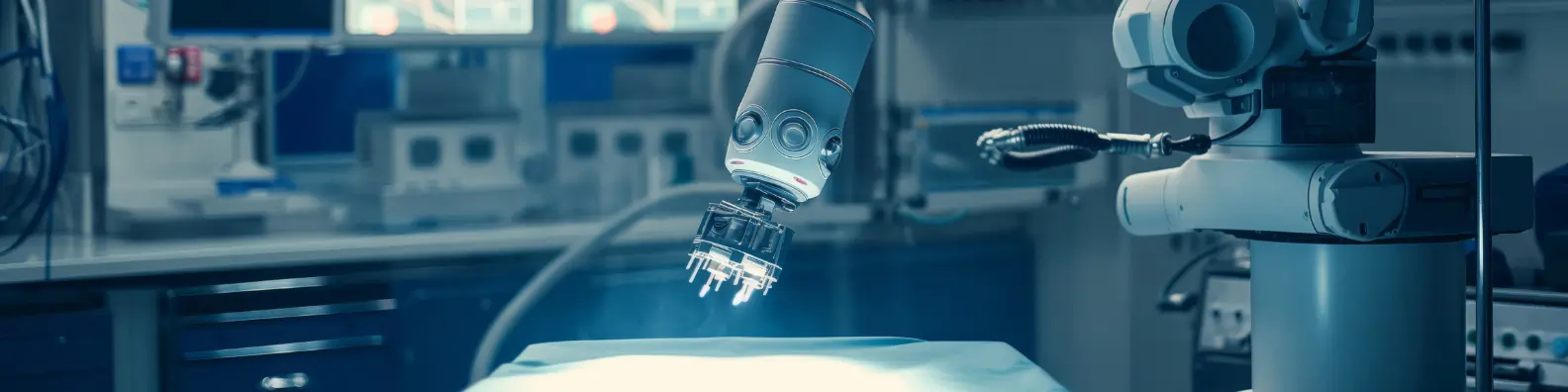
The medical devices CDMO market is becoming increasingly influential in product development and the long-term commercial success of OEMs. The relationship has become a strategic partnership model, with CDMOs increasingly shaping how medical technologies are designed, scaled, and brought to market. This has an effect on how organisations structure their leadership teams and the type of talent required to compete in a rapidly evolving market.
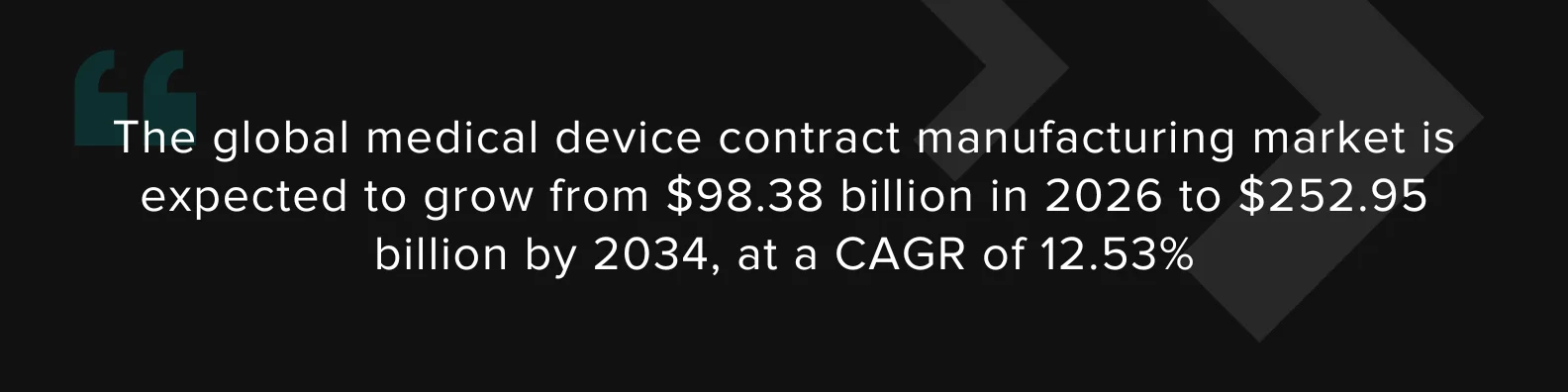
The global medical device contract manufacturing market is expected to grow from $98.38 billion in 2026 to $252.95 billion by 2034, at a CAGR of 12.53%. This is driven by increased product complexity, the convergence of software and hardware, and increasing pressure on OEMs to accelerate innovation while maintaining quality and compliance.
In this article, we explore the key trends we’re seeing in the medical devices CDMO market, the technologies driving innovation, and the leadership skills in high demand.
Contact CSG Talent to connect with senior executives across medical devices, CDMO, and life sciences.
Contract manufacturing in the medical device industry was once primarily about solving capacity challenges. OEMs led product design, regulatory strategy, and commercial direction, while manufacturing partners focused on volume and efficiency. However, that model no longer reflects the demands of today’s market. As devices become more complex, manufacturing decisions now directly influence product performance and time to market.
To manage this complexity and reduce risk, OEMs are increasingly engaging CDMOs much earlier in the development process, with them now involved in prototyping, design, validation, and scaling manufacturing. This shift has transformed the relationship from a transactional supplier model into an end-to-end partnership focused on the full product lifecycle.
Driven by private equity investment, shifting political landscapes, and manufacturers looking to reduce risk in product launches, the medical device CDMO market has taken a central role in the industry. While the term “CDMO” is often linked to pharmaceuticals, the MedTech outsourcing market is attracting both established leaders and new investors eager to capitalise on its growth.
Supply chain resilience is another key trend, as geopolitical uncertainty and regional regulation differences continue to expose the risks of heavily distributed manufacturing models. In response, we are seeing a renewed focus on reshoring and regional manufacturing strategies.
This will become even more common in 2026, with major capacity expansions already underway in Europe and North America. For many OEMs, proximity and reliability have overtaken labour costs as the most important factors in manufacturing location decisions.
Sustainability is now a key market requirement, as regulations such as the EU’s Packaging and Packaging Waste Regulation accelerate the move away from PFAS and other “forever chemicals” towards bio-based and recyclable materials. CDMOs that can demonstrate life cycle assessments and material traceability are increasingly favoured when it comes to supplier selection, making sustainability a key differentiator in contract awards and long-term partnership decisions.
Free trade zones such as those in Costa Rica are becoming increasingly important to the medical device CDMO landscape, offering proximity to the US market alongside lower operating costs, favourable tax structures, and a growing base of skilled manufacturing professionals.
This trend is reflected in Cretex Medical’s continued expansion in the region, including its agreement to acquire Atemisa Precisión, a specialist machining business based in the Alajuela Free Trade Zone. The deal follows Cretex’s announcement of a new 65,000 sq. ft. facility in Cartago. Together, these investments highlight how nearshoring and regional manufacturing hubs are reshaping capacity, supply chain resilience, and growth strategies across the CDMO market.
In 2026, leading CDMOs are using AI and machine learning to automate elements of computer-aided design, allowing engineers to input performance criteria and generate hundreds of optimised designs much quicker.
This approach is reducing R&D cycles by as much as 30% while improving manufacturability and cost predictability. AI also helps CDMOs identify compliance risks earlier and reduce the need for redesigns by embedding regulatory and quality requirements into the design process.
Digital twins allow CDMOs to create virtual versions of production lines and simulate manufacturing processes before physical production begins. By digitally testing different scenarios, organisations can identify risks and predict equipment issues early in the process. In 2026, this approach is becoming increasingly standard practice for complex or highly regulated programmes, as it improves yield and reduces downtime.
Additive manufacturing is already commonly used for prototyping, but it has now also moved into regulated production environments, where it works closely with traditional CNC machining. These hybrid models allow companies to manufacture complex geometries and patient-specific components that were previously difficult to scale.
This is especially relevant in areas such as orthopaedics and surgical devices, where precision and customisation are increasingly expected. It also supports more localised manufacturing strategies, helping CDMOs reduce lead times and improve responsiveness.
As devices continue to become more complex, OEMs are increasingly relying on CDMOs for specialist capabilities they cannot easily maintain in-house, particularly in areas such as electromechanical design, integration, and testing.
As the CDMO market evolves, a variety of executive roles have become crucial for managing complexity and driving innovation:
Across these leadership roles, CDMOs are seeking executives who can operate in multiple different disciplines, as the ability to align engineering, quality, regulatory, digital, and commercial teams around shared goals has become essential. Communicating risks to OEM partners in a way that builds trust is also important, as manufacturing decisions increasingly influence product safety and time to market.
There is also growing demand for leaders who understand how technologies such as Generative AI can accelerate design and development, as well as where automation introduces new validation and compliance risks that require careful human oversight. As CDMOs expand, executives must integrate new systems and cultures without disrupting quality or delivery.
Jabil and Flex are two of the most influential companies in digital medical device manufacturing. Both organisations are recognised for their strength in automation, systems integration, and global supply chain management, supporting products such as smart inhalers and continuous glucose monitors. Their ability to combine hardware production with software integration makes them strong partners for OEMs commercialising connected and data-driven devices.
Integer is a leader in cardiovascular and neuromodulation technologies, where precision and are essential. The business is widely known for its work on next-gen implantable devices, including leadless pacemakers and neuro-stimulators. As devices become smaller and more advanced, Integer’s engineering quality continues to set it apart.
Phillips-Medisize is a global leader in outsourced development and manufacturing for drug delivery, combination products, and connected devices. The company is recognised for its expertise in precision engineering, advanced injection moulding, and integrated electronics, enabling OEMs to bring complex devices to market efficiently. Its end-to-end capabilities position it as a trusted partner for manufacturers seeking both technical excellence and regulatory compliance.
Companies such as Veranex, Europlaz, and Nemera are gaining visibility for their design-led approach and focus on advanced drug delivery and precision manufacturing. Their growth reflects the shift toward more targeted capability, faster development cycles, and closer collaboration with OEMs earlier in the product lifecycle. Rather than competing on pure scale, these businesses prioritise technical expertise and the ability to support projects from start to finish.
As CDMOs take on a more strategic role, leadership hiring has become a core driver of long-term performance. Senior leaders are now expected to balance delivery with digital transformation and the management of long-term OEM relationships.
At the same time, candidates are increasingly favouring organisations that are investing in technology, maintaining strong quality systems for advanced devices, and building structures that can scale without compliance risks. Businesses that fail to show this strategic direction will struggle to attract the level of senior leadership required to support growth.
While experienced engineers and operations professionals are available, there is a shortage of those with highly specialised skills and hands-on experience with ISO 13485. Executives who can combine deep technical expertise with knowledge of manufacturing, regulations, digital systems, and customer expectations are in high demand, making this one of the major growth challenges within the CDMO market.
Many of the strongest leaders in the sector are not actively seeking new roles. Most of them are already involved in major projects or managing key customer relationships, which makes them hard to reach through traditional recruitment methods. As competition increases, the impact of a poor leadership hire has become more significant, particularly for customer trust and long-term credibility.
Executive search specialists provide access to this leadership market by combining deep industry knowledge with established networks across medical devices and contract manufacturing.
CSG Talent specialises in senior-level executive search across medical devices and the wider life sciences manufacturing ecosystem, with expertise in both OEM and CDMO environments. By combining industry insight with established leadership networks, CSG Talent helps organisations identify executives who can manage complexity, strengthen OEM partnerships, and build scalable operations for the future.
Contact CSG Talent to secure leadership executives capable of scaling operations and managing complex CDMO environments.