Drop off your CV
We'd love to hear from you. Send us your CV and one of our specialist consultants will be in touch.



Global expansion is a natural stage of growth for many OEMs, particularly as expansion into Europe and North America becomes a strategic priority. These regions offer significant opportunity, with established infrastructure investment and well-developed distribution networks.
Many Asian OEMs are entering with strong products and clear ambition, but consistent success can be difficult to achieve. This raises an important question around why capable businesses with competitive offerings often struggle to gain traction during heavy equipment market entry across these regions.
In this article, we explore why Asian OEMs struggle in Western markets and how aftermarket, leadership, and dealer strategy drive successful expansion in Europe and North America.
Contact CSG Talent to secure the leadership talent required for successful international expansion.
Many Asian OEMs enter Europe and North America with a clear advantage in product competitiveness. The historical quality gap has narrowed significantly, with newer entrants such as Sany, XCMG, and HD Hyundai, Sinoboom, and LGMG now matching established Western brands at a lower cost. This creates genuine opportunity at the point of entry, as products are usually strong enough to generate early interest from both dealers and end users. The challenge is whether the organisation can support it in a way that maintains that initial momentum.
Alongside product strength, many OEMs bring a high level of ambition to new markets, often backed by aggressive growth targets and a willingness to invest quickly. This can create early traction, particularly when combined with competitive pricing and a strong value proposition.
However, speed alone does not translate into long-term success in Western markets. Rapid expansion without the supporting infrastructure can expose gaps in service and dealer support, so growth needs to be built on stability as much as ambition.
Europe and North America are fundamentally different from many domestic markets, as they have more complex regulations, more established competitors, and a strong reliance on long-term relationships across dealer networks and customer bases. Expansion strategies that rely on speed and control can struggle to translate in these environments, particularly when local teams are not given the flexibility to respond to market conditions in real time.
As a result, the challenge is often not technological capability but organisational misalignment between headquarters and the regional business, which ultimately determines whether early momentum can be turned into long-term growth.
Expansion into Europe and North America requires a different approach to dealer network development, as these relationships are built on long-term trust rather than short-term commercial opportunity. Without investment in service capability, parts availability, and infrastructure, dealers are unlikely to commit resources or prioritise the brand. Growth therefore becomes slower and more difficult to maintain, regardless of how competitive the product may be.
Many OEMs entering Western markets make the right initial move by hiring experienced local leaders with strong networks and market knowledge, but the impact of these hires is often limited when decision-making remains centralised at headquarters.
When approvals for pricing, dealer onboarding, and commercial terms sit outside the region, organisations lose the speed and flexibility needed to respond to market conditions. This is particularly critical in relationship-driven environments, where delays can weaken credibility and delay momentum. OEMs that fail to address this find it challenging to turn early interest into long-term growth, as local teams are unable to operate with the responsiveness required to build trust and compete effectively.
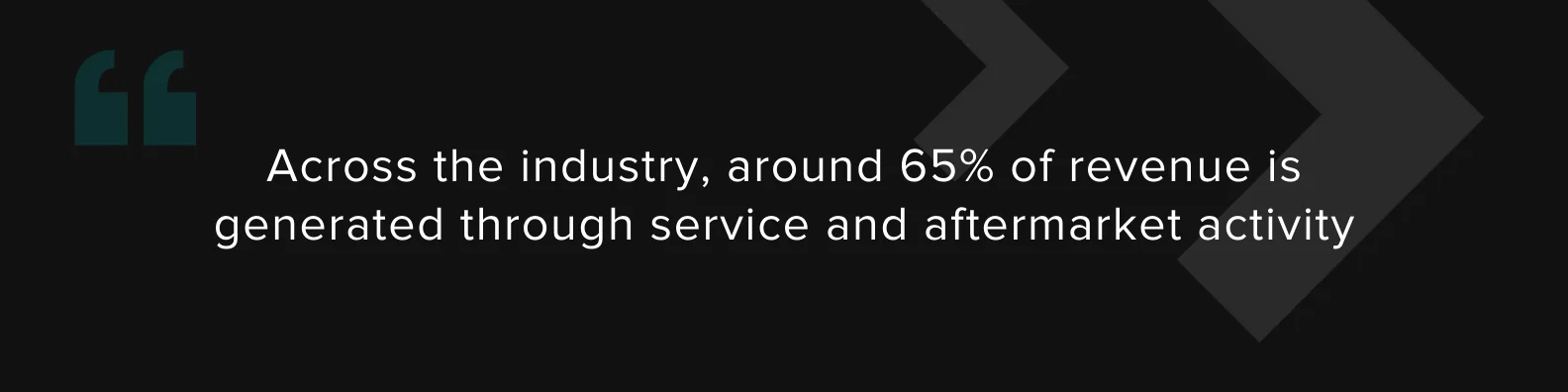
One of the most significant shifts required when entering Western markets is recognising that the construction equipment aftermarket is a core driver of revenue and brand credibility. Across the industry, around 65% of revenue is generated through service and aftermarket activity, which changes how customers and dealers evaluate OEMs.
Buying behaviour follows a similar trend, with around 70% of new equipment sales coming from repeat buyers, and nearly 90% of those customers actively engaging with aftermarket services. Customers don’t expect to simply buy a machine but to also invest in long-term reliability and support.
When aftermarket infrastructure is underdeveloped or introduced too late, dealers hesitate to commit, customers question long-term reliability, and the overall ownership experience begins to fall short of expectations. This creates a gap between initial sales success and long-term performance, limiting the ability to scale effectively.
The OEMs that gain real traction in Europe and North America recognise these requirements early and structure their expansion strategy accordingly. Rather than focusing solely on market entry, they invest in the foundations required to operate effectively in these regions.
They prioritise aftermarket from the outset, building service capability and technical support before scaling sales, which signals long-term commitment and increases dealer confidence. They empower their leadership teams with real autonomy, allowing decisions to be made closer to the market and enabling faster responses to customer and dealer needs. They also take a long-term approach to dealer development, demonstrating consistency in investment, leadership, and strategy, which builds the trust required for dealers to fully commit to the brand.
Expansion into Western markets is only successful when supported by leadership with the right expertise and experience. Businesses need executives who have deep industry relationships, a proven track record in scaling dealer networks, and the capability to build aftermarket infrastructure from the ground up.
At CSG Talent, our heavy equipment executive search specialists work as strategic consultants to help dealers, equity groups, and OEMs identify and secure the next generation of leadership talent. With deep industry knowledge and a global talent network, we help businesses establish the foundations for sustainable growth and long-term market success in complex international markets.
Partner with our heavy equipment executive search experts to identify and secure the talent required to build dealer confidence and support long-term growth in Western markets.
Articles:
Podcasts: