Drop off your CV
We'd love to hear from you. Send us your CV and one of our specialist consultants will be in touch.



Warehouse automation has become a key aspect of modern supply chain strategy, as technologies such as autonomous mobile robots (AMRs) and AI-driven intralogistics systems improve efficiency and reduce costs.
In the APAC region, adoption is driven by e-commerce growth, industrial modernisation, and demand for faster fulfilment. Many of these trends are also reflected across other regions, as companies worldwide face similar pressures to optimise operations and manage complex logistics networks.
In this article, we explore the evolving technology landscape and talent challenges that companies must understand to stay competitive and maximise their automation initiatives in 2026.
Contact CSG Talent to secure the specialist talent needed to deliver complex automation projects.
Large-scale automation projects often face lengthy approval timelines as organisations remain cautious with capital expenditure. Automation initiatives require careful planning and alignment with broader business strategies, which can extend sales cycles and slow pipeline conversion.
To manage these pressures, many organisations are exploring modular automation solutions and robotics-as-a-service models. These approaches allow businesses to adopt advanced automation technologies with lower upfront investment while still improving efficiency.
Another critical global challenge is the shortage of specialised talent. Demand for roles such as control engineers, robotics specialists, software integration experts, and senior technical leadership continues to significantly outpace supply. The skills gaps directly impact project timelines and limit the scalability of new initiatives.
Many companies rely on external System Integrators (SIs) to bridge these gaps, but the lack of local, skilled talent still limits the overall speed and effectiveness of implementation. As companies are increasingly recognising this issue, strategic talent planning and recruitment partners are becoming essential to build resilient teams capable of ensuring automation projects meet their objectives.
The ability to integrate solutions seamlessly while maintaining maximum uptime has become a key factor in how automation partners are selected. Reliability and rapid response capabilities have become increasingly important for securing and delivering automation projects.
Because of this, end-users are prioritising partners with proven engineering expertise, on-site support, strong after-sales service, and suppliers that can adapt to this new focus and provide full lifecycle support.
Clients expect more from automation than ever before, with robotics and AI optimisation now seen as minimum requirements. A particularly transformative trend emerging is the rise of agentic AI, which are autonomous systems capable of making independent decisions regarding procurement, inventory management, and production scheduling. Facilities that successfully integrate intelligent robotics and AI for intralogistics report a 30% to 40% reduction in travel time for materials compared to traditional systems.
Warehouse automation investment continues to accelerate as organisations respond to increased demands, talent challenges, and the need for more resilient supply chains. APAC is expected to remain a major growth hub, with countries such as China, Japan, South Korea, India, and Australia investing heavily in advanced warehouse technologies.
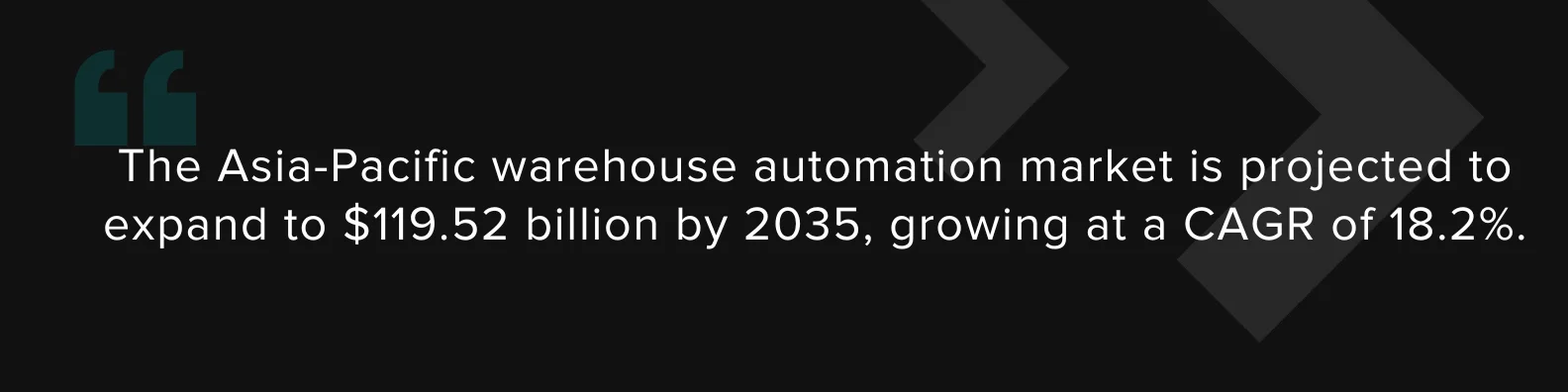
The Asia-Pacific warehouse automation market is projected to expand to $119.52 billion by 2035, growing at a CAGR of 18.2%. This will make it the fastest-growing region in the world, reflecting both the scale of activity in the region and the commitment to modernising facilities earlier in their lifecycle, rather than retrofitting ageing infrastructure.
This growth aligns with the global trend of automation adoption, as the AMR market is expected to grow at a CAGR of over 15.1% through to 2030, mainly driven by the logistics and warehousing sectors.
While North America and Europe primarily invest in automation to address talent shortages and strict regulations, emerging markets are taking a different approach to adoption by gradually scaling their automation infrastructure with flexible solutions that require less upfront capital expenditure.
In North America, innovation in warehouse automation is shaped by scale and complexity. Operators managing large, multi-site networks are investing heavily in end-to-end integration and collaboration platforms that can coordinate thousands of automated assets in real time. The focus is less on how quickly automation is introduced and more on the ability to maintain performance across high volumes and peak demand periods.
Europe’s approach reflects a different set of priorities. Energy efficiency and sustainability targets play a key role in how automation strategies are developed. Many European organisations are adopting robotics and intralogistics technologies that reduce energy consumption and align with long-term environmental goals, while also supporting existing workforces. Automation is often introduced in phases, with a strong focus on resilience and compliance rather than maximum scale.
Across APAC, innovation tends to prioritise flexibility and speed of deployment. Modular automation platforms and robotics-as-a-service models are becoming increasingly common, particularly in fast-growing logistics and e-commerce environments. In many markets, automation is being introduced earlier in the development of warehouse networks, creating opportunities to design facilities around scalability and future technology upgrades.
Regional leaders across APAC, including companies such as HikRobot and Geek+, show how this approach works in practice. Their deployment of AMRs in high-volume environments has improved real-time insight and enabled greater scalability during peak demand. The key takeaway from APAC is that automation delivers the greatest value when technology decisions are closely aligned with people, processes, and long-term strategy.
As warehouse automation evolves worldwide, success increasingly depends on leaders and technical specialists who can deliver complex projects, integrate robotics and AI systems, and optimise supply chain performance.
At CSG Talent, we have a specialist team of warehouse automation recruitment experts operating within automation software, WMS, ASRS systems, and 3PL. We support businesses with their warehouse automation recruitment across various industries, placing senior-level talent into a range of in-demand automation jobs globally.
By strengthening leadership and technical teams, we help organisations future-proof operations, scale effectively, and stay ahead in the rapidly evolving automation landscape.
Contact our warehouse automation recruitment experts to secure the talent you need to innovate and grow.