Drop off your CV
We'd love to hear from you. Send us your CV and one of our specialist consultants will be in touch.


AI in industrial automation has become significantly more advanced in recent years. Automating repetitive tasks and reducing labour costs were the original selling points, but in 2026 the focus has shifted to agentic AI, where systems make autonomous decisions in complex environments without the need for human instruction.
The global AI in industrial automation market is expected to grow to $72.5 billion by 2033 at a CAGR of 21.9%. 92% of manufacturers now consider smart manufacturing the primary driver of their future competitiveness, and 78% are directing more than 20% of their total improvement budget toward AI initiatives. The question for most businesses is no longer whether to invest, but where to focus and how to build the teams capable of delivering results.
Ownership of AI in industrial automation rarely sits within a single function. While engineering, operations, and IT all play a role, implementation is typically led by dedicated AI leaders who coordinate across these teams. As organisations develop their capabilities, ownership typically moves into a dedicated AI or data function, with clear accountability for delivery and performance.
In this article, we explore the key applications of AI across industrial automation, the roles driving technology forward, and the talent implications for businesses.
Contact CSG Talent to future-proof your leadership team.

Traditional maintenance has always operated on one of two modes, either fixing equipment after it fails or servicing it on a fixed schedule, and neither approach is particularly efficient. AI changes this by analysing real-time sensor data and monitoring variables like vibration, heat, and sound to identify anomalies before a fault occurs. When the system detects a problem, it checks spare part inventory and generates a work order automatically, without a technician needing to be involved at that stage.
In 2026 this has evolved further into prescriptive maintenance, where AI actively adjusts machine load to extend its operational life until the next planned maintenance. Early adopters report reductions in unplanned downtime of between 26% and 50%, which is critical in high-speed facilities where production stopping for just an hour can cost millions of dollars.
High-resolution cameras now capture thousands of images per second, comparing each against an ideal digital model and flagging anomalies in real time. An even more significant development is zero-shot learning, as it enables AI to identify defect types it has never encountered before by understanding what a correct product looks like well enough to catch any discrepancies.
Vision-language models take this even further by detecting flaws in composite materials that standard inspection wouldn't find. Gartner predicts 50% of supply chain professionals will have adopted AI-enabled vision systems by the end of 2027.
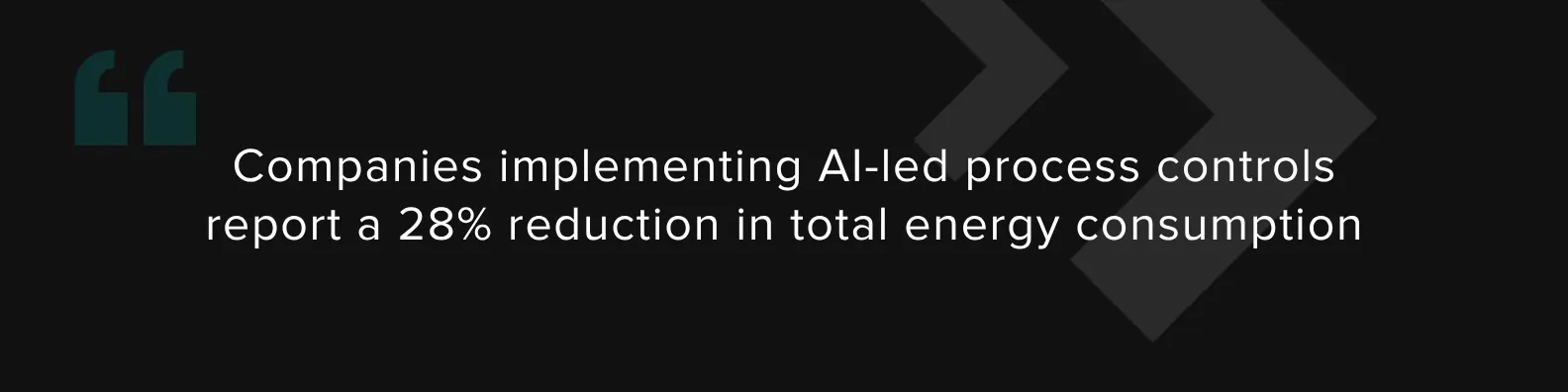
Industries such as chemical processing and steel manufacturing rely on hundreds of variables operating simultaneously, including temperature, pressure, flow rate, and timing. Industrial AI makes millisecond adjustments to optimise yield and energy efficiency without the need for human intervention, with companies implementing AI-led process controls reporting a 28% reduction in total energy consumption.
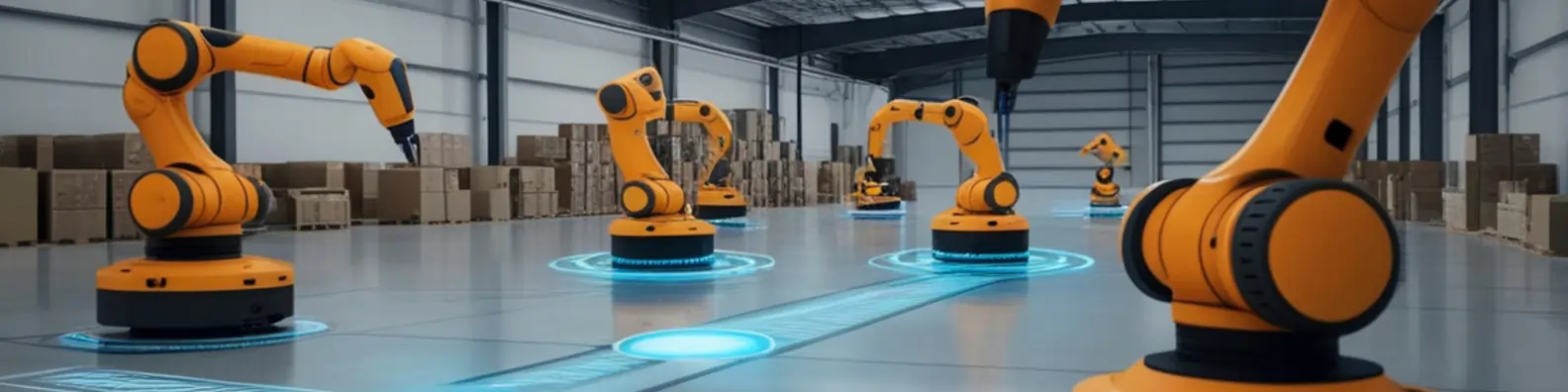
The key development in industrial robotics in 2026 is adaptability. Introducing a new component to a production line once required specialist reprogramming, but now collaborative robots (cobots) can use foundation models to interpret tasks contextually. In many cases, simply showing a cobot a new part is enough for it to determine how to handle it, removing a challenge that manufacturers have had to work around for years.
Safety is also a key consideration in this shift. Cobots equipped with advanced spatial sensors can detect when a human enters their operating zone and immediately slow or stop, making collaboration between humans and robots on a shared factory floor both practical and viable.
AI supply chain systems monitor thousands of external data points simultaneously, including weather patterns, port congestion, geopolitical conditions, and fuel prices, and act on that information before disruption occurs. If a storm is forecast to delay a key component shipment, the system sources from a secondary supplier or adjusts the production schedule weeks ahead rather than reacting afterwards. This is making AI-optimised supply chains 23% more profitable than those still running on manual data entry and spreadsheets.
A digital twin is a live virtual replica of a physical facility, updated in real time by sensor data from the factory floor. It lets operators run detailed simulations and production scenarios in a risk-free environment before committing to any physical changes on site. Sim-to-real accuracy has reached 99% in 2026, making digital twins a valuable tool for executive decision-making, capacity planning, equipment investment, and production strategy.
Machine Learning Engineers play a critical role in ensuring predictive systems remain accurate and reliable over time. While building an initial model is relatively straightforward, the real challenge is managing model drift, where performance gradually declines as machinery ages, leading to false positives or missed early warning signs.
In 2026, the most in-demand professionals are those who take a proactive approach by developing maintenance models that account for asset degradation from the outset, rather than treating it as a reactive issue.
The role of the Robotics Engineer has evolved significantly as cobots have become standard across shared production environments. Perception and spatial intelligence are now just as critical as movement mechanics, as these capabilities enable robots to operate safely and intuitively alongside human workers. Employers are increasingly prioritising candidates who can train robots in simulated environments within digital twins before deployment.
AI Automation Architects are emerging as one of the most strategically important but hardest to fill roles in industrial AI. These professionals bridge the gap between operational technology (OT) and information technology (IT), which previously operated independently. Integrating real-time sensor data into financial forecasting and analytics platforms is a complex, technically demanding task that requires industrial systems to be aligned with data-driven insights.
Demand is particularly strong for candidates who understand agentic workflows where multiple AI systems operate autonomously and collaboratively, but the supply of this expertise is extremely limited.
Computer Vision Engineers are now driving quality control innovation, as advances in multispectral inspection, including infrared and X-ray AI, allow organisations to detect internal defects that would previously have gone unnoticed. This has significantly raised the standard for quality assurance across industrial environments. However, with this being such a technical role, candidates with proven experience deploying these solutions in live production settings are still in short supply.
Industrial environments generate large amounts of sensor data, but signals from equipment operating under extreme conditions can often be inconsistent, making data quality a critical concern. Organisations are seeking professionals who understand that industrial data is a continuous timeline, where the Sequence of Events (SOE) is critical to predicting future performance and building reliable data pipelines.
RAG Engineers represent one of the newest and most critical roles within the industrial AI sector. They focus on connecting large language models to an organisation’s technical knowledge base, including maintenance manuals, engineering specifications, and operational procedures.
This enables AI systems to deliver accurate, context-specific insights when technicians encounter unfamiliar issues. Without strong RAG implementation, AI systems may provide false or generic answers that could lead to costly errors or safety hazards on the factory floor.
Boards are increasingly treating AI risk on the same level as financial and operational risk. As autonomous systems take on greater decision-making responsibility, accountability is shifting to the leadership level, with roles such as Chief Robotics Officer and Head of AI now carrying clear governance and risk management responsibilities.
The most in-demand leaders are those who can clearly outline return on investment for AI initiatives while also maintaining a clear understanding of system limitations and where human oversight is required.
The specialists driving AI in industrial automation are in extremely high demand right now, and the organisations securing the right talent are experiencing significantly improved operational performance.
At CSG Talent, we work with businesses across the automation sector to identify and place the engineers, architects, data scientists, and senior leaders capable of delivering the integrated solutions that turn data into competitive advantage. Whether you’re building out a team or filling a critical capability gap, we can help you secure the talent that will shape the future of the industry.
Contact our Industrial Automation Recruitment Experts to secure the senior engineers and leaders driving transformation.