Drop off your CV
We'd love to hear from you. Send us your CV and one of our specialist consultants will be in touch.



In 2026, businesses are navigating skills shortages, rapid technological advancement, shifting workforce expectations, and increasing pressure to hire top talent at pace without compromising on quality. As highlighted in our 2026 Hiring Trends, the organisations performing strongest are those that approach hiring with structure and direction rather than reacting to immediate pressure.
At executive level, the cost of a bad hire can be at least 30% of their annual salary once you account for bonuses, benefits, lost productivity, and management time. This is where a structured hiring checklist becomes critical, as it ensures each hire is aligned with your wider business objectives, improves consistency in decision-making, and protects your investment long after the offer is signed.
In competitive markets, hiring success is often determined by momentum. From the moment you receive a CV through to final offer, maintaining pace, clarity, and communication is critical, as delays or a weak candidate experience can quickly derail even the strongest hiring strategy.
Here is a practical 2026 hiring checklist to help you plan effectively, attract the right leaders and talent, and build teams that deliver strong long-term performance. We also include insights from the talent acquisition manager of a leading business in the dairy industry throughout the article.
If your business is planning senior or specialist hiring in 2026, contact our executive search experts today.
Before opening a new role, review how your hiring performed over the past 12 months by looking beyond time-to-hire and considering quality of hire and early retention.
Ask yourself:
Up to 20% of staff turnover occurs within the first 45 days, often because expectations were unclear from the outset. Reviewing your previous hiring decisions allows you to identify whether challenges came from role definition, interview structure, decision delays, or onboarding gaps. Without this reflection, the same issues are likely to repeat themselves.

Before approving a vacancy, ensure you are clear on why the role exists. Is it supporting growth, filling a skills gap, strengthening leadership, or enabling transformation?
Hiring without this clarity often leads to reactive decisions driven by workload pressure rather than strategic direction. When you define the true business objective behind the hire, you can assess candidates more objectively and avoid changing criteria during the process. The clearer you are about what success looks like, the easier it becomes to identify it.
As automation and AI continue to reshape roles, focusing purely on previous experience limits your access to adaptable talent. A skills-first approach shifts your attention to what candidates can do and how transferable their capabilities are. In fact, 94% of employers say skills-based hiring is more predictive of on-the-job success than traditional CV screening. Conduct a skills gap analysis to consider how requirements may evolve over the next few years to ensure you are hiring for future performance, not just immediate delivery.
Even the strongest hiring strategy will stall if budgets and timelines are not aligned with market conditions. High-calibre professionals often remain on the market for around 10 days before accepting an offer, so if your internal approval processes or compensation frameworks are not prepared in advance, you risk losing strong candidates before decisions are made. When hiring is treated as a strategic investment, you position yourself to act decisively when the right talent becomes available.
Outdated or overly complex job descriptions can restrict your talent pool, so make sure yours define outcomes, responsibilities, and success measures rather than listing excessive requirements. When you clearly articulate what success looks like in the first 6 and 12 months, candidates can assess their own suitability more accurately. It also means your interview panel will have a consistent framework for evaluation, which strengthens alignment across decision-makers and reduces confusion later in the process.
Once your internal processes are aligned, the focus shifts to how you present the opportunity to the market and the candidate experience you provide. In 2026, candidates evaluate you as thoroughly as you evaluate them, meaning your employer brand plays a decisive role in whether high-performing professionals engage with you. Around 77% of candidates research potential employers on platforms such as LinkedIn and Glassdoor before applying.
Review how your organisation appears externally. Is your messaging consistent across channels? Do your leaders communicate clearly about strategy and direction? Are your values demonstrated in how you operate?
When your external positioning aligns with your internal culture, you attract candidates who are genuinely aligned with your direction.
Candidates expect clear timelines, consistent communication, and a well-managed interview structure. Around 21% of professionals expect interviews to be scheduled within a few days of initial contact, and many will disengage if communication is slow or unclear.
The interview process is a reflection of how your organisation operates. Candidates assess your leadership alignment, communication style, and decision-making speed throughout the process. A disjointed or prolonged experience can signal internal uncertainty, particularly at senior level.
Streamline your interview stages so that each step has a clearly defined purpose and ensure every interviewer understands what they are responsible for evaluating. Even if you’re facing uncertainty when choosing between candidates, avoid adding additional stages as this often slows decision-making and signals hesitation to candidates.
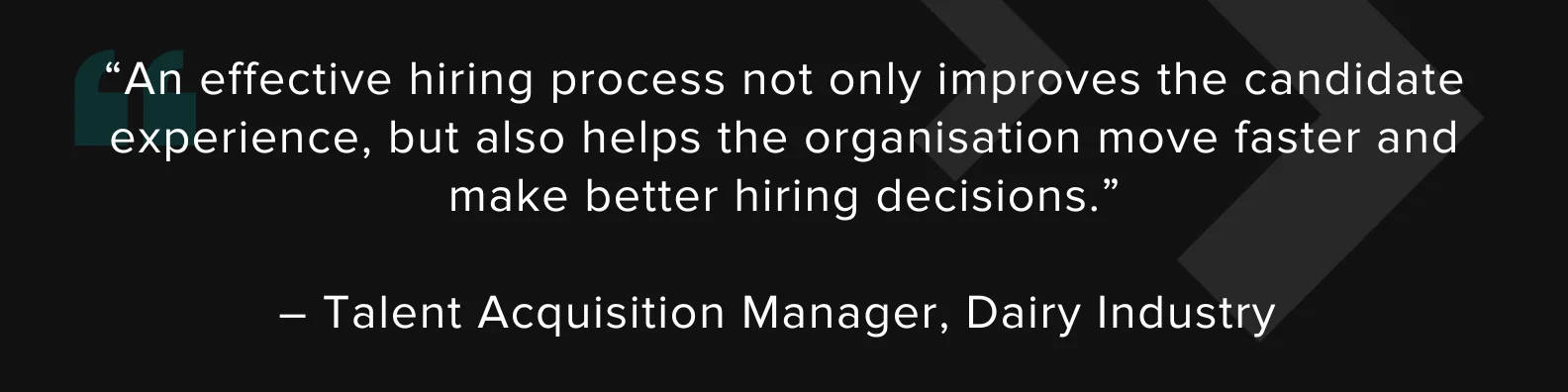
As a leading Talent Acquisition Manager in the dairy industry explains:
“An effective hiring process is extremely important. It not only improves the candidate experience, but it also helps the organisation move faster and make better hiring decisions. When the process is clear, consistent, and efficient, candidates feel valued, hiring managers stay engaged, and recruiters can focus their time on high-impact work rather than administrative delays.”
Hiring momentum is built or lost between receiving the CV and final offer, and even well-planned processes can stall if decision-making lacks clarity or urgency. Delays between interview stages, conflicting feedback, or slow internal approvals negatively impact candidate experience and weaken your competitive position.
Misalignment between leadership teams is one of the most common causes of lost momentum. When evaluation criteria are unclear or feedback is inconsistent, processes extend unnecessarily and strong candidates disengage.
Senior-level professionals often have multiple opportunities at the same time, and their decision windows are short. Once you identify a candidate who aligns with your strategic objectives and capability requirements, hesitation can quickly undo the work you have invested in the process.
Acting decisively does not mean lowering standards or rushing the process. It means avoiding preventable delays, maintaining momentum, and demonstrating that your organisation is clear and confident in its decisions. A streamlined process reinforces your employer brand and signals to candidates that your organisation is aligned, professional, and serious about securing the right talent.
Compensation transparency is now crucial, with 41% of candidates losing interest in a role if the salary range is not transparently listed. Why would a candidate invest time in a process without knowing if it aligns with their salary expectations? Your offer should also clearly outline:
The period between offer acceptance and the candidate starting the role is high-risk, particularly when experienced professionals can still receive counteroffers or be approached by other recruiters. Without engagement, even committed candidates can begin to reassess their decision, so it’s important to maintain consistent and purposeful communication during this phase.
This can be done by sharing details about the onboarding plan, clarifying early priorities, and outlining how the role contributes to your wider business objectives. This approach maintains momentum and reduces the risk of last-minute dropouts.
Once your new hire starts, a structured onboarding experience is vital as it can improve retention by 82% and increase productivity by more than 70%. It’s important to define what success looks like in the first 6-12 months, ensuring objectives are commercially aligned and measurable. You should also provide clarity around decision-making processes and cultural norms so that integration happens quickly and effectively.
Long-term retention is closely linked to growth and capability development. The 2025 LinkedIn Workplace Learning Report found that 76% of employees are more likely to stay with a company that offers continuous training, particularly as roles evolve in response to technological change.
Development should be built into the role from the outset, including upskilling, leadership development, exposure to emerging technologies, and structured mentoring. When you demonstrate that development is an ongoing priority rather than an occasional initiative, you strengthen engagement and future-proof your workforce.
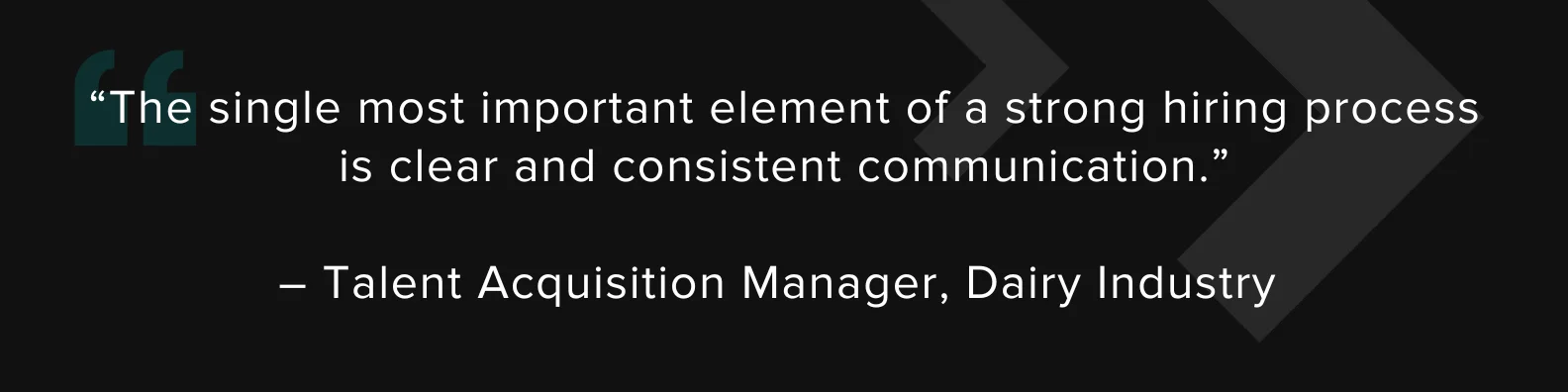
In competitive and fast-moving markets, businesses benefit massively from external expertise. An experienced recruitment partner provides expert insight into salary benchmarks, candidate experience, and evolving skills requirements, helping you make informed and confident hiring decisions.
At CSG Talent, we help businesses refine their hiring strategy and identify leaders with the right skills and mindset for the future. With industry-specialised recruiters in over 30 different sectors, we provide a consultative approach to executive search that allows us to support organisations through growth and transformation.
Contact CSG Talent for support attracting and retaining senior-level talent.